
EUROMA AWASHISH
 Eruoma Awashish is an Atikamekw Nehirowisiw visual artist with a Bachelor’s degree in lnterdisciplinary Arts from the Université du Québec à Chicoutimi. She is currently pursuing a master’s degree in research-creation focused on the decolonization of the sacred.
Recipient of the Contemporary Art Award from the Musée national des beaux-arts du Québec, she has taken part in several major exhibitions, including Révélations Biennial (Paris, 2023), the MURA Museum in Mexico, and the lndigenous Contemporary Art Biennial (2078, 2024). Originaly from Opitciwan and now based in Mashteuiatsh, she develops an artistic practice grounded in spirituality, territory, and memory, exploring a decolonized reading of the sacred through reinterpreted symbols. As part of the National Building Reconciliation Forum, UQAC invited Eruoma Awashish and master’s student and sculptor Thomas Meloche to collaboratively create a sculptural work. This arch, conceived as a symbol of memory and passage, will be installed at the entrance to the UQAC food forest as a lasting legacy of the forum.
ROSALIE GUAY
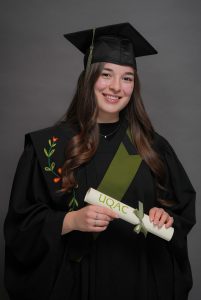 Originally from Saint-Félicien in the Lac-Saint-Jean region and Anishinaabe from Kitigan Zibi, Rosalie Guay is pursuing a master’s degree in art at the Université du Québec à Chicoutimi. Having grown up far from her community, Rosalie has been engaged in a process of cultural reclamation for several years. Currently, her creations reflect her search for identity and her desire to merge the development of her artistic practice with her process of cultural reclamation.
She graduated from UQAC with a bachelor’s degree in interdisciplinary arts and specializes in animation, specifically stop-motion and specializes in animation, more specifically stop-motion animation. The tactile nature of frame-by-frame animation allows her to bring objects to life with her hands, thereby conveying her sensitivity and her stories. The scenographic design process enables her to engage deeply with materiality, experiment with new techniques, and incorporate traditional beadwork or other Anishinaabeg traditional techniques into her art.
ELISABETH ST-GELAIS
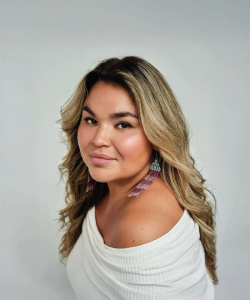 An Innu from the community of Pessamit and originally from Saguenay, Elisabeth St-Gelais places great importance on sharing her culture through her artistic mission. She is committed to reconciliation among Indigenous Peoples in Canada and proudly represents the Innu of the Côte-Nord, her Nation. She is a soprano who advocates for reconciliation with First Nations, Métis, and Inuit peoples across Canada by including Indigenous works in her repertoire.
MATEN
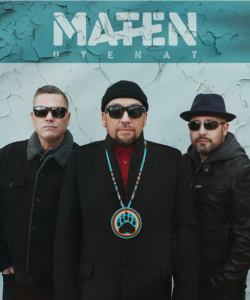
Maten, consisting of Samuel Pinette, Mathieu Mckenzie, and Kim Fontaine—is an Innu band from Mani-utenam on Québec’s North Shore, rooted between the shores of the St. Lawrence River and the boreal forest.
Respected by their peers and long recognized by the public (nominated at the 2019 ADISQ Gala), Maten has released a fourth album with a confident, festive alternative folk-rock sound. One of the band’s defining characteristics is their commitment, expressed through their lyrics, to their community, their language, and their Innu roots. Their songs convey their values and culture, as well as pride in their identity. The message is strong and direct—forward-looking yet grounded in reality—addressing the challenges that communities continue to face.

