
Wednesday june 10th
8 am to 10 am
Student Center
This activity is aimed at people registered for the Forum.
The opening ceremony will officially kick off the Forum.
In the presence of the 2025 hosts, a symbolic object will be passed on—a powerful and unifying gesture that embodies continuity, remembrance and shared commitment.
This ceremonial segment will include:
- Officialwelcomeremarks
- Addressesfrom partner representatives
- A tribute tosurvivorsof residential schools
- Recognition ofcommunitiesand distinguished guests
The ceremony will be held in the presence of:
- Ghislain Samson,Rector, UQAC
- Danielle Rousselot,Director, Centre des Premières NationsNikanite and Head, Relations with First Peoples
An artistic performance will mark the moment, anchoring the opening in a vibrant cultural and identity-rich dimension.
This ceremony will set the tone for the Forum: gathering, recognition, dialogue and a shared commitment to the future.
Charles Bender – Presenter

Charles Bender – Wendat
Actor/Director/Translator
Charles Bender is an actor, host, translator, and director of Wendat and settler origin. He is co-artistic director of the theatre company Menuentakuan and the host of Sans Reserve on APTN. He has sat on many committees and boards of directors that have social justice and contemporary Indigenous culture as part of their mandate.
Charles has been involved in theatre and television for more that 20 years and is often asked to host events that spotlight the exceptional richness of Indigenous peoples and organizations.
Ghislain Samson
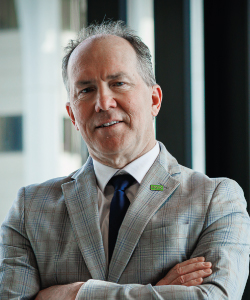
Ghislain Samson, Rector, Université du Québec à Chicoutimi (UQAC)
Ghislain Samson holds a PhD in secondary science education (UQTR/UQAM). He began his career as a professor at Université de Sherbrooke (2004–2008) before joining the Department of Education at UQTR. While Ghislain Samson is a specialist in science education and in the transfer of learning in math and science, his work also explores curriculum development, interdisciplinary teaching and environmental education. In addition, he has conducted research on students with challenges, youth employability and workforce integration, the impact of entrepreneurial approaches to teaching and digital learning. He served as Director of the Department of Education from 2014 to 2016, then became Dean of Academic Affairs in 2017. Since August 2021, he has been serving as Rector of UQAC.
Gabriel Miller
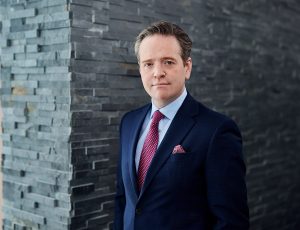
Gabriel Miller is the President and CEO of Universities Canada. With more than 22 years of leadership experience in the non-profit sector, he brings strong expertise in member relations, advocacy, stakeholder engagement and public policy. He previously served as President and CEO of the Federation for the Humanities and Social Sciences. In his current role, he works to advance the mission of Universities Canada by building partnerships, championing higher education and helping shape policies that strengthen research and teaching across the country. Outside his professional work, he has served on numerous non-profit boards of directors and most recently on the advisory committee for the Government of Canada’s Diamond Jubilee.
Lori Campbell
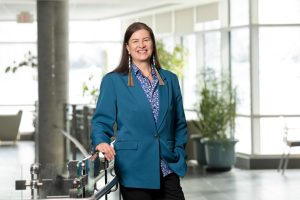
Lori Campbell is the Associate Vice‑President (Indigenous Engagement) at the University of Regina, where she leads institution‑wide efforts advancing Indigenous engagement, reconciliation, and decolonization. Guided by the Truth and Reconciliation Commission’s Calls to Action and the United Nations Declaration on the Rights of Indigenous Peoples, her work focuses on building meaningful relationships grounded in respect, responsibility, and accountability.
A proud Two‑Spirit member of Montreal Lake Cree Nation from Treaty 6 Territory, Lori has over 20 years of leadership experience across student services, academic programming, and senior administration. Her leadership is rooted in Indigenous teachings and community‑informed governance, ensuring Indigenous worldviews are embedded in institutional structures.
Lori holds a Master of Adult Education and is completing a Ph.D. in Social Justice Education at the University of Toronto, focusing on Indigenous women’s leadership. A national award recipient and Co‑Chair of the National Indigenous Senior Leaders Association, she also inspires others as a storyteller, ultramarathoner, and CBC’s Canada’s Ultimate Challenge participant—encouraging action, courage, and shared responsibility in reconciliation.
Jacqueline Ottmann
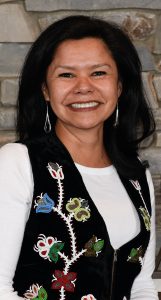 Dr. Jacqueline Ottmann is Anishinaabe (Saulteaux) from Fishing Lake First Nation in Saskatchewan. Prior to her academic career, Jackie was an elementary, high school teacher and principal. She remains an engaged scholar alongside her responsibilities as a senior academic leader. While at the University of Calgary, she was the Coordinator of the First Nations, Métis, Inuit undergraduate teacher education program, and Director of Indigenous Education Initiatives within the Werklund School of Education (WSE). She also co-chaired the WSE Indigenous Strategy, and alongside the Provost, the university-wide Indigenous Strategy.
After her time with the University of Saskatchewan as Professor and Vice-Provost Indigenous Engagement, Jacqueline Ottmann was appointed President of the First Nations University of Canada. Ottmann has been recognized as an international researcher, advocate, and change-maker whose purpose is to transform practices inclusive of Indigenous leadership, methodologies, and pedagogies. Jacqueline is driven to create schools and communities that foster a deeper sense of belonging and appreciation for Indigenous peoples – their histories, stories, ways of knowing and being. Ottmann is also the first Indigenous person to become President of the Canadian Society for the Study of Education.
Michèle Audette
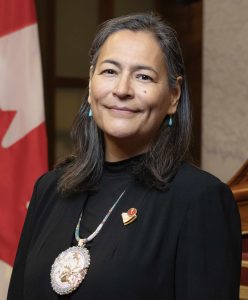
Senator Michèle Taïna Audette grew up immersed in both the Innu and Québec cultures. She was born in Wabush, Labrador, and spent her early years in Schefferville, Mani-utenam, and Montréal.
From a very early age, she has experienced discrimination as both a woman and an Indigenous person, and she has dedicated herself to pursuing equality, equity, and social justice.
She became president of Quebec Native Women at the age of 27, then president of the Native Women’s Association of Canada, and has also served as commissioner for the National Inquiry into Missing and Murdered Indigenous Women and Girls.
In the fall of 2019, she joined Université Laval as a senior advisor for reconciliation and Indigenous education.
She was appointed Senator in July 2021.
Recognized for her work in promoting reconciliation and defending the rights of Indigenous women, Michèle Audette is a leading figure in the promotion of social justice in Canada.
For her involvement, the University of Ottawa, Université de Montréal, and Saint. Paul University have awarded her three honorary doctorates.
Sharon Hatcher
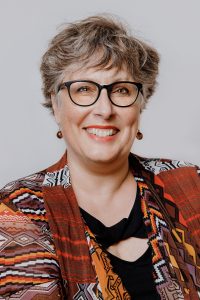 Family physician, professor at the Université de Sherbrooke, and assistant for social accountability at the Faculty of Medicine and Health Sciences, Dr. Hatcher is attentive to power inequalities and the inclusion of diversity. She has developed a particular interest in the health of First Peoples and contributed to the creation of the Miro Matisiwin clinic at the Mamik Saguenay Centre. A leader in Indigenous health, Dr. Hatcher raises her colleagues’ awareness of cultural safety while encouraging them to address social inequalities in health.
Carina Dominique
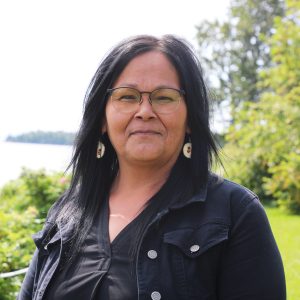 Carina Dominique is Vice-Chief of First Nations and Government Relations for the Pekuakamiulnuatsh First Nation. Elected to a second term, she notably chairs the Shakashteu process, which is working on the development of a Youth Protection Act. Trained in social work and coming from a family deeply engaged in politics, she continues this legacy of commitment to her community with conviction.
Jacques Newashish
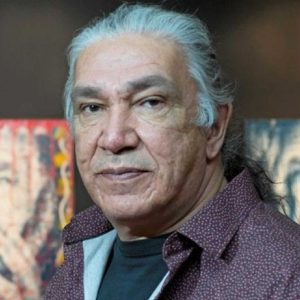
Homme authentique, profondément attentif à l’humain et au territoire, Jacques Newashish contribue depuis près de quarante ans au rayonnement artistique, social et culturel de sa communauté. Dès l’âge de 24 ans, il devient le premier illustrateur du Conseil de la Nation Atikamekw, participant à la création d’outils éducatifs en langue atikamekw. Artiste visuel reconnu, M. Newashish se distingue en dessin, gravure et peinture, et fait rayonner la culture des Premières Nations au Québec et en Europe.
Avec le temps, il élargira sa pratique au chant au tambour, au conte, à la sculpture et à l’écriture, tout en se démarquant également comme acteur. Médaillé de l’Université du Québec à Chicoutimi (UQAC), il est aussi Aîné autochtone en résidence à l’Université du Québec à Trois-Rivières (UQTR), où il agit comme passeur de savoirs. Récipiendaire de la Médaille des bâtisseurs Culture Mauricie, Jacques Newashish a bâti une œuvre dont l’influence est durable.
Thérèse Bégin
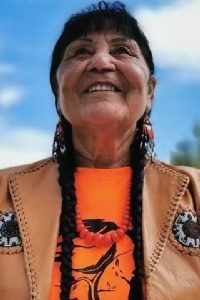 Thérèse Thelesh Bégin was born in Mashteuiatsh but grew up in Chibougamau Park, her father’s hunting territory. She was born into a Catholic family and bears the Innu name “Thelesh,” which closely resembles her baptismal name, Thérèse. The name “Thelesh” refers to her curiosity, and she says it has influenced her throughout her life. Since the early 2000s, Thelesh has exhibited her work in Mashteuiatsh, Montréal, Ottawa, and Washington. The artist passes on her knowledge to her own children and grandchildren so that it may continue through future generations.
Marie-Ève Hervieux
 Marie‑Ève Hervieux is an Innu woman originally from Pessamit and a long‑time resident of the Mani‑utenam community. A mother of three children, she has lived a life marked by many challenges, but also by great inner strength. Through the Red Path, ceremonies, and spiritual teachings, she overcame her addiction to alcohol and drugs. A natural helper, she has been singing sacred ceremonial songs for over ten years with her teueikaniss (hand drum), offering her voice at gatherings, conferences, and funerals. She now works as a cultural liaison at the Mani‑utenam elementary school, where she proudly shares Innu culture.

